Fibre tip size and handpiece setup affect your day-to-day laser use by controlling how accurately you can apply energy to the treatment area. Even a small change in the setup can affect how the laser delivers energy and how the tissue responds during treatment.
Most clinics we speak with at GPIAG order dental laser fibre tips based on their usual routine rather than the procedure requirements, then wonder why the cutting feels slower this month. The reality is that this routine can add extra chair time and increase consumable use.
Not to mention, oral disease keeps plenty of chairs busy. It affects close to 3.7 billion people worldwide, according to the World Health Organization. Even small improvements in soft tissue procedures can help clinics handle treatment more efficiently.
With that in mind, this guide covers dental laser fibre tip sizes, tip types, different setups, and the day-to-day care that keeps your results consistent. Let’s get into it.
Fibre Tip Diameter and Length: Why Size Changes Everything
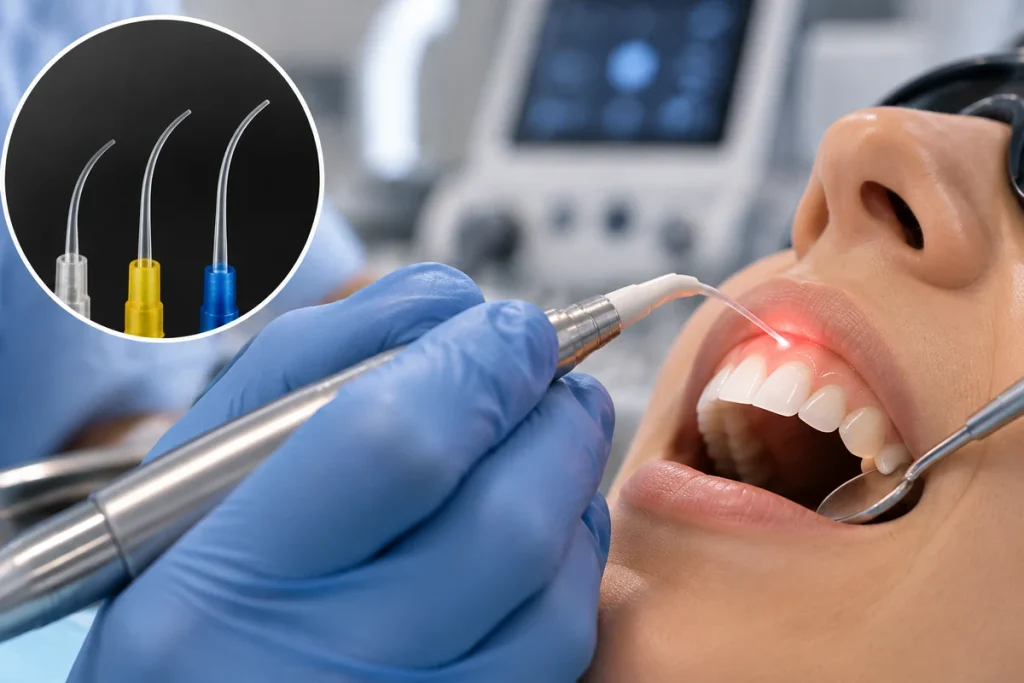
Most clinicians blame the laser machine when a worn or oversized tip is the main problem. The diameter sets how tightly light concentrates at the fibre end, while reach determines where your hand is positioned. As fibre tip diameter decreases, power density increases, so confirm both values before placing a reorder.
Small Diameter Tips for Precision Soft Tissue Work
Narrow tips around 200 to 300 microns squeeze energy into a small spot. You get a fine, controlled line through gingival tissue. That focus suits procedures such as:
- Troughing around tooth margins
- Frenectomies to adjust restrictive tissue attachments
- Sulcular debridement to clean infected gum pockets
On the other hand, wider beams drag the margin out by half a millimetre. Charring is also reduced at lower power settings.
In practice, a 200 micron tip covers most cosmetic soft tissue laser treatment in a general clinic (easily our most reordered size).
Longer Reach Tips for Posterior Access
The reach of dental laser fibre tips determines whether you can access a second molar comfortably, without twisting your wrist.
Standard tips give you about 4 mm of working fibre. Meanwhile, longer versions extend past 7 mm for deep pockets and distal surfaces. That extra length keeps the handpiece clear of opposing teeth, so your sightline stays open.
In fact, every hygienist we’ve trained on posterior pocket therapy keeps both lengths on the tray. The shorter option helps with access and control, while the longer fibre provides reach when working deeper areas.
Contact Us to Confirm the Right Tip Size for Your Handpiece
Handpiece threads and fibre housings differ between brands. As a result, a tip that seats perfectly in one unit might sit loose in another.
If you’re not sure which one you need, send us your model number, and we’ll match the connector, diameter, and length before you order a box. You can also contact us with a photo of the collar if the model plate has worn off, or follow our product line updates for new laser tip releases (your details stay covered by our Privacy Policy).
Tip: Plenty of catalogues list these as “fiber” instead of “fibre”, so search both spellings.
Contact and Non-Contact Tips Serve Very Different Jobs
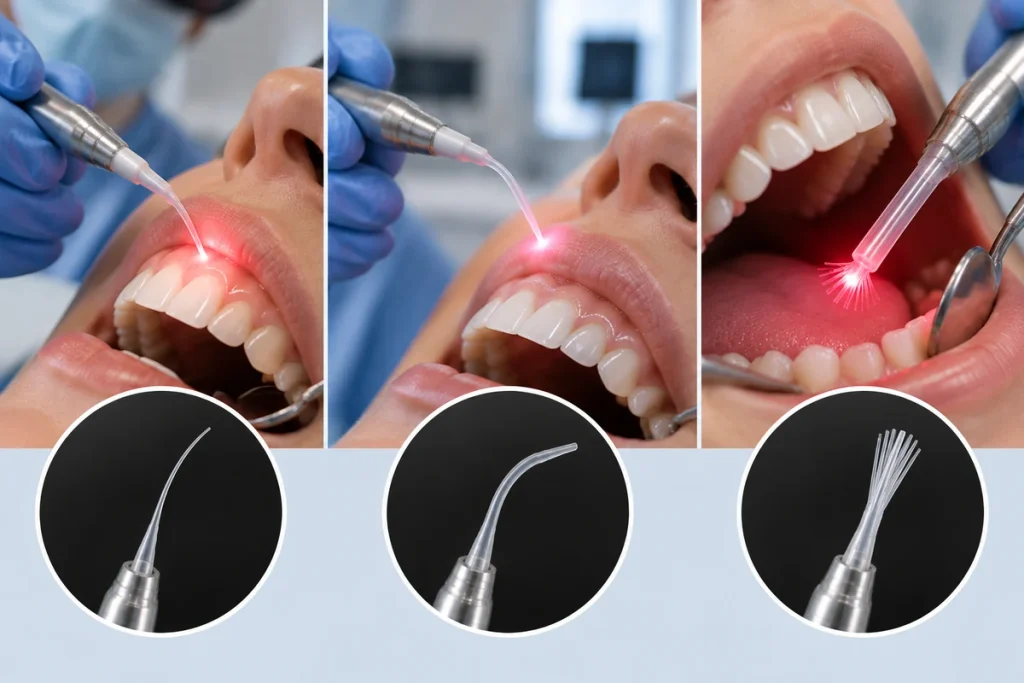
When you match the tip type to the procedure, you get cleaner margins and less stray tissue effect. Contact tips work by touching the tissue directly, which allows the clinician to guide the laser energy exactly where it’s needed. On the flip side, non-contact tips work from a short distance above the tissue, and a radial fiber tip spreads energy sideways. Here are the differences:
| Tip Type | Best For | Typical Diameter |
|---|---|---|
| Contact tips | Precise, direct cutting on soft tissue, troughing and frenectomy | 200 to 400 microns |
| Non-contact tips | Broader coagulation, ablation, and surface decontamination | 400 to 600 microns |
Bottom line: Use contact tips for cutting procedures and non-contact tips for surface treatments. One style won’t cover both jobs, and running a bare fiber dental laser with no shaped tip sits between the two.
Tip choice also depends on the laser system itself, because not every wavelength uses the same delivery method. For instance, carbon dioxide systems use a hollow waveguide.
Teeth whitening uses a different approach, with the laser directed at the whitening agent rather than cutting or removing tissue. For ablative procedures, the laser removes tissue through controlled energy delivery, which can place more wear on the tips over time.
How Does Diode Laser Handpiece Setup Affect Delivery?
Diode laser handpiece setup affects delivery by controlling fibre alignment, power output and the angle the tip meets tissue. Three quick checks sort out almost all of it.
Checking Fibre Alignment Before Each Appointment
A quick-fire test onto articulating paper shows whether the fibre still sits centred in its housing. The mark it leaves behind tells you whether the alignment is still correct.
You’d want a round, even burn mark square in the middle. It shows the fibre is positioned correctly and distributing energy evenly. An off-centre or crescent mark means the fibre has shifted, so energy leaves at an angle.
Honestly, this simple check takes only fifteen seconds and saves you from blaming the unit mid-procedure.
Setting Diode Power for the Procedure
Power settings change what the tip does to tissue. In general, soft tissue troughing usually sits near 0.8 to 1.2 watts in continuous wave, while deeper excision runs closer to 2 watts. Apart from that, pulsed settings allow heat to dissipate between pulses. That helps control temperature buildup and protect surrounding tissue.
We’ve watched clinicians drop from 2 watts to 1.2 and get a cleaner margin with less post-op soreness.
Finding Handpiece Information for Your Specific Model
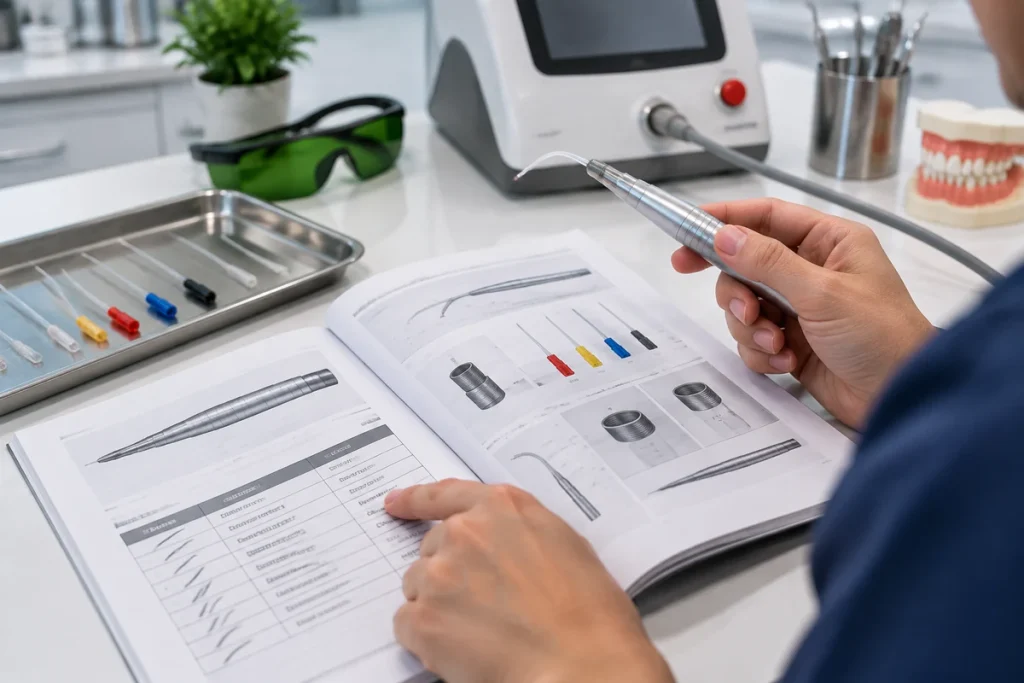
Manufacturers publish tip compatibility in the handpiece manual, usually in a table near the back. That page also lists thread type, fibre diameter range, and maximum power. Check the laser features and warranty terms too, since some brands void coverage if you fit third-party fiber tips.
If the manual has gone missing (it probably has, in someone’s drawer), the model number on the collar can get you the same details. But if you’re still unsure, feel free to contact us for the spec sheet.
Building a Daily Care Routine for Your Laser Dentistry Equipment
With tip type and setup sorted, the last piece is a simple routine. Laser dentistry equipment usually declines through gradual wear rather than sudden failure. Regular care like this can maintain consistent performance over time:
- Daily Wipe Down: Clean the tip and handpiece with an alcohol wipe after each patient, before protein debris bakes onto the glass. Residue soaks up energy, and it belongs in your infection control routine anyway.
- Weekly Inspection: Cracking, discolouration, or charring along the fibre shows under loupes long before a tip stops cutting. Hold it to a light and check the last few millimetres.
- Scheduled Replacement: Replace dental laser fibre tips when wear begins to affect cutting precision. As a general rule of thumb, disposable tips give you roughly five to ten procedures, depending on power and contact time.
Worth Noting: Log every tip change beside your autoclave records. Clinics that keep those records find their ordering becomes more efficient.
Get the Right Dental Laser Fibre Tips for Your Handpiece
Dental laser fibre tip size, tip type, and handpiece setup all work in combination. When you get all three with the correct measurement, your unit feels consistent and predictable again. None of it requires new technology, just careful attention to the small components you handle every day.
So pull the manual out this week and check what your current tips are rated for. Then order the sizes that match your common procedures instead of whatever turned up last time.
GPIAG supplies dental laser fibre tips, handpiece parts and related products for dental and surgery teams. Contact us to confirm the right fit and find out what we hold in stock.