Adopting laser technology in dentistry involves more than adding a new tool to your workflow. It introduces specific clinical, regulatory, and operational requirements that take time to address.
But many clinics underestimate what’s required before lasers can be used safely and legally. As a result, gaps in compliance, training, or setup often only become apparent once implementation has already begun.
This article covers the laser dentistry requirements every dentist needs to know, including Therapeutic Goods Administration (TGA) requirements, state radiation licensing, and mandatory training standards. It also outlines what to consider from a practical standpoint so you can make informed decisions before investing.
Let’s dive in.
Laser Dentistry Requirements: What Australian Regulations Actually Expect
Laser dentistry in Australia sits under two layers of oversight, federal and state. Each layer comes with specific requirements for dental practices. And we’ll explain each one below.
TGA Approval and What It Means for Your Dental Clinic
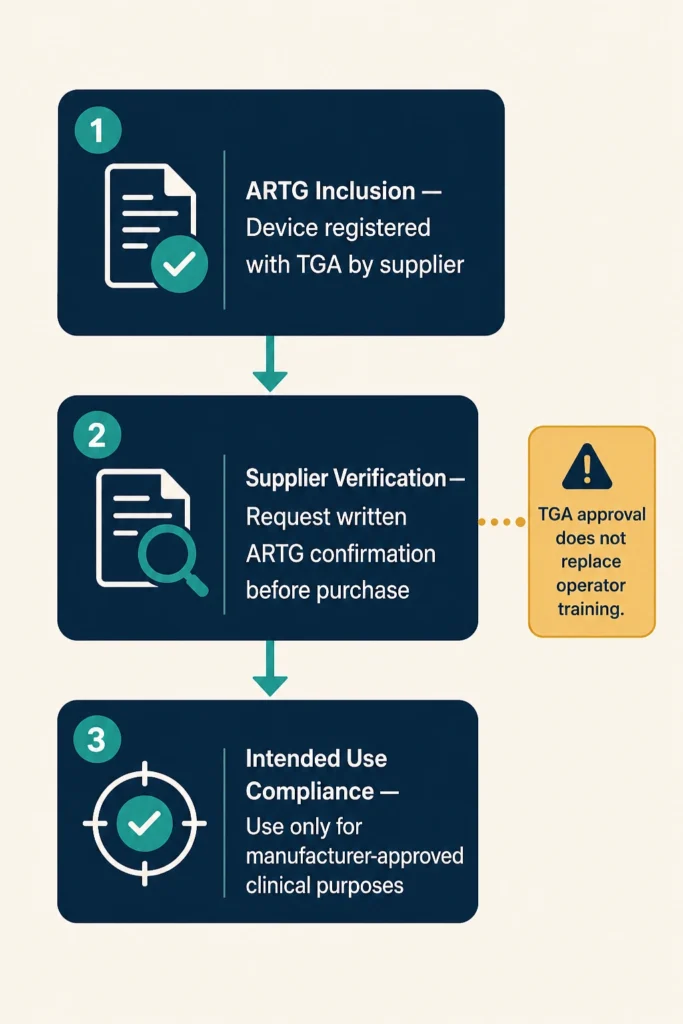
TGA approval determines how dental lasers are supplied and used in Australia. Before one reaches your clinic, it needs to meet three specific legal requirements:
- ARTG Inclusion: Dental lasers supplied in Australia must be included in the Australian Register of Therapeutic Goods (ARTG) and meet TGA device requirements. Responsibility for that inclusion sits with the sponsor, typically the importer or manufacturer.
- Supplier Verification: Before purchasing any dental equipment, ask your supplier for written confirmation of ARTG inclusion. Using an unapproved device carries serious legal and insurance consequences that fall on your practice, not theirs.
- Intended Use Compliance: Dental lasers must only be used for their approved clinical purposes, as specified by the manufacturer and recorded in the ARTG documentation.
Worth Noting: TGA registration confirms the equipment meets Australian safety and performance standards. However, it does not replace proper operator training before clinical use.
Radiation Health Licensing: State by State
Once TGA approval is sorted, the next question is whether your clinic is licensed to use the laser. That answer depends entirely on which state you’re in.
For example, Queensland manages radiation health licensing through Queensland Health, while Victoria regulates it under the Radiation Act 2005. In Western Australia, it falls under the Radiation Safety Act 1975, administered by the Department of Health. Meanwhile, the Australian Radiation Protection and Nuclear Safety Agency (ARPANSA) provides national codes and safety guidance across all states. Licensing, however, remains a state-level requirement with its own application process, fees, and renewal schedule.
Those state-by-state differences compound for practices operating across multiple locations. Each jurisdiction requires its own licence, and that adds administrative and financial complexity worth factoring into your compliance timeline early.
Training Requirements Before You Use the Equipment
In Australia, practitioners are typically required to prove competency before using dental lasers clinically, although specific requirements vary by state. At a minimum, training should cover laser physics, tissue interaction, safety protocols, and emergency procedures.
Without that broader foundation, training focused only on device operation is unlikely to meet state licensing conditions or prepare practitioners for complications during treatment. This reflects guidance from the Australian Dental Association, which recommends formal training before any clinical use.
Quick Note: Some suppliers, including those distributing ASA dental lasers in Australia, offer accredited training as part of the purchase package. This approach can simplify the compliance process for practices adopting the technology.
Diode, CO2, or Er:YAG: Choosing the Right Laser for Your Dental Practice
Dental lasers fall into three main categories: diode, CO2, and Er:YAG. Each targets different tissue types and procedure sets, so the right choice depends on what your practice actually does day to day.
The following covers what most state authorities assess:
1. Diode Laser: This is the most widely adopted option in general dental practice. It’s compact, lower in cost, and handles soft tissue procedures well, which makes it a natural starting point for clinics new to laser dentistry.
2. CO2 Laser: If your primary focus is oral surgery or lesion removal, this type delivers strong clinical results. It does require a more stringent safety setup, so it tends to suit specialist or surgical environments better than a general clinic.
3. Er:YAG Laser: Unlike the other two, Er:YAG is the only type that works on both hard and soft tissue. That means cavity preparation and dentinal treatments are possible alongside soft tissue work.
In working with dental practices across Australia, we’ve seen most general clinics start with a diode laser. It covers a broad range of everyday soft tissue procedures with a lower training and setup requirement compared to CO2 and Er:YAG systems.
Dental Equipment Checklist Before Your First Laser Procedure
The laser unit is just one piece of the puzzle. There’s a range of supporting equipment every clinic needs to have in place before a procedure can safely go ahead. At a minimum, your clinic will need:
- Wavelength-specific protective eyewear for both operators and patients
- A smoke evacuator rated for laser plume
- Reflective surface covers in the treatment room
- A laser warning sign for outside the treatment room door
- A documented laser safety manual
- A nominated laser safety officer on staff
If you’re missing even one of these before your first procedure, it can delay your licensing approval or put your clinic at compliance risk.
Laser Safety in Practice: Protecting Staff and Patients
Most clinical risks in dentistry are visible and well understood. Laser-related risks, however, are less obvious and often underestimated in practice. They typically stem from three main sources: the laser beam itself, the plume generated during treatment, and reflective surfaces within the clinical environment. And standard infection control training does not fully address these hazards.
Laser plume is a good example. It’s the smoke generated when laser energy interacts with tissue, and evidence published in PubMed Central confirms it can contain bacteria, viral particles, and potentially carcinogenic compounds. This is why appropriate ventilation and smoke evacuation systems are considered essential during every procedure.
Beyond plume exposure, staff require specific training on beam hazard zones and reflective surface risks. Patients also need wavelength-specific protective eyewear fitted before any laser is activated, as accidental exposure to an unprotected beam carries serious risk.
A written laser safety policy ensures these requirements are applied consistently for everyone in the room. It should cover incident reporting procedures, equipment checks, and staff responsibilities. Without it, compliance gaps often go unnoticed until an incident occurs.
Treatment Room Requirements for Safe Laser Use
Your existing treatment room may not automatically qualify for laser use. Some states set minimum space requirements, and the physical setup of the room carries just as much weight as the paperwork.
The table below covers what most state authorities assess:
| Requirement | Specification |
| Minimum room size | Some jurisdictions set minimum space requirements before a radiation use licence is granted |
| Window coverage | Windows must be covered with appropriate blinds or barriers to prevent accidental beam exposure |
| Reflective surfaces | Reflective materials should not be present within the laser’s operational field |
| Electrical supply | The room must support safe and stable electrical requirements for the laser unit |
| Signage | A laser warning sign must be displayed outside the treatment room during procedures |
| Adjacent areas | Staff in nearby areas, including reception, should not be exposed to laser hazards |
With that in mind, clinics modifying an existing room may still require inspection or approval from their state radiation authority before clinical use begins. When planning a new setup, factoring these requirements into the design stage can help reduce delays.
Ready to Bring Laser Dentistry Into Your Practice?
Getting across the laser dentistry requirements in Australia takes time. And the compliance side involves multiple regulatory bodies with different expectations depending on your state and laser type.
The requirements covered in this article are the same ones every Australian dental practice works through before going live with laser technology. None of them is insurmountable, and most clinics find that once the compliance groundwork is done, the rest of the setup follows naturally.
Dental Laser Therapy has supported Australian dental practices through TGA approval, radiation health licensing, and complete equipment setup for over 20 years. Reach out to talk through what your practice specifically needs before making any decisions.